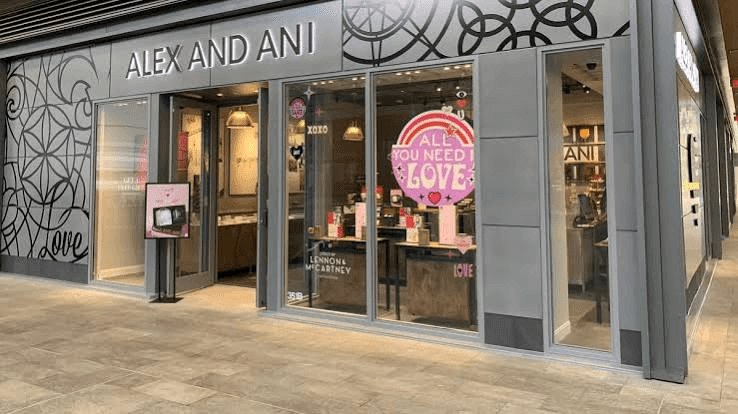

At its peak, Alex and Ani ran over 100 stores across the U.S., Canada, and Puerto Rico. The founder, Carolyn Rafaelian, was once worth nearly $1 billion. By early 2024, the brand was down to six stores. That is not a gradual decline — that is a collapse.
But here is the important detail: Alex and Ani has not formally shut down. The website still operates. A small number of stores remain open. The brand exists — just as a fraction of what it once was.
This article breaks down what actually happened, where the brand stands today, why it fell apart, and what customers with gift cards or warranties should know.
From 100 Stores to a Handful — A Quick Timeline
Carolyn Rafaelian founded Alex and Ani in 2004 in Rhode Island. The brand is named after her two daughters. It built its identity around charm bangle bracelets — affordable, symbolic jewelry that caught on quickly during the 2010s.
The first retail store opened in 2009. Within a few years, the brand expanded aggressively. At its peak, it operated more than 100 locations across the U.S., Canada, and Puerto Rico.
Then things started moving in the wrong direction:
- June 2021: Alex and Ani filed for Chapter 11 bankruptcy in Delaware. At that point, it had 74 store leases, with 25 already closed because of COVID.
- Mid-2023: The company shut down 20 more stores and vacated its Rhode Island headquarters, leaving only seven stores open.
- Early 2024: The Disney Springs location closed, bringing the total down to six U.S. stores.
Going from 100+ locations to six in roughly three years is a dramatic contraction. But it still does not equal a full shutdown — and that distinction matters for customers and business observers alike.
Why Alex and Ani Filed for Chapter 11 Bankruptcy
It is tempting to blame COVID-19 for everything that went wrong. The pandemic certainly made things worse. But the deeper problems were already there before the first lockdown.
The Debt Problem
At the time of the bankruptcy filing, Alex and Ani carried roughly $127.4 million in total debt, along with approximately $29.1 million in unsecured trade debt. That is a heavy load for a jewelry brand built on relatively low-price-point products.
That kind of debt does not appear overnight. It builds up through years of aggressive expansion funded by borrowed money — money that needs to be repaid even when sales slow down.
Overexpansion
The brand grew fast, and not all of that growth was backed by sustainable demand. Think of a restaurant chain that opens 40 locations in two years. If those restaurants are not filling seats, the rent still comes due every month. Alex and Ani faced a similar situation. Demand for its signature charm bangles was already softening before the pandemic hit.
When you combine declining product demand with a large network of fixed-cost retail leases, the math gets ugly fast.
Internal Conflict
There was also a significant legal and personal dispute between Rafaelian and the private equity firm Lion Capital, which had invested in the brand. According to Forbes, Rafaelian went from being worth nearly $1 billion to losing most of that — roughly $900 million — in under two years.
That kind of conflict between a founder and investors does not stay behind closed doors. It drains management attention, legal resources, and the focus needed to run a business effectively. It contributed directly to the brand’s instability heading into 2021.
COVID was the final push on an already tipping structure — not the root cause.
What “Chapter 11” Actually Means for a Retail Brand
A lot of people hear “bankruptcy” and assume a business is done. That is not always true, and it was not immediately true for Alex and Ani.
Chapter 11 is a reorganization process, not liquidation. It allows a company to restructure its debts and operations under the supervision of a bankruptcy court, while continuing to trade. Think of it as a legally supervised reset rather than a shutdown order.
During its bankruptcy process, Alex and Ani kept its open stores running and its website active. The plan involved selling assets, terminating store leases, and resolving the ownership dispute involving Rafaelian’s 35% equity stake.
Rafaelian ultimately sold her stake and exited the company. New ownership took over and continued operating the business under a much smaller structure.
The outcome was not liquidation. It was a drastically smaller business — still alive, but operating at a fraction of its former scale. For customers wondering whether their purchases or gift cards were simply gone, the answer at the time was no. The brand was still there. Just much reduced.
Where Alex and Ani Stands Today
As of early 2024, the brand had approximately six U.S. stores remaining — down from over 100 at its peak and 74 at the time of the bankruptcy filing. The Rhode Island headquarters was vacated in mid-2023. Manufacturing has reportedly been largely outsourced, and operational control shifted away from its New England roots.
The brand now functions primarily as an e-commerce business with a minimal physical footprint. No publicly announced complete shutdown has occurred as of the most recent available reporting, but the picture is not a recovery story either.
This is a brand in survival mode, not growth mode. The current strategy appears to focus on direct-to-consumer online sales and a leaner, streamlined product range — rather than rebuilding a large retail network.
Important note: The exact number of stores still open in 2025 is not confirmed by current sources. If you need the most up-to-date location information, check the Alex and Ani website directly before making a trip.
What This Means for Customers
If you have an Alex and Ani gift card or a product under warranty, here is the practical picture:
- Gift cards: If your local store has closed, you likely cannot use the card there. Online redemption may still be possible through the website — but verify this directly with customer service before assuming.
- Warranties and returns: These policies can change during and after restructuring. Check the brand’s current policy rather than relying on what was offered at the time of purchase.
- Store locations: With only a small number of stores remaining, do not assume the nearest location is still open. Confirm before traveling to a mall or shopping center.
Retail restructuring often leaves customers in limbo on these questions. The safest approach is to contact the company directly and get a clear answer in writing.
The Broader Business Lesson
Alex and Ani is a useful case study in what happens when growth outpaces demand. The brand had a real product that resonated with a large audience. It was a genuine success story for several years. But rapid physical expansion, heavy debt, and a breakdown in leadership created a business that could not absorb the shock of shifting consumer tastes and a global pandemic.
It is a pattern seen across retail: a brand gains momentum, takes on debt to fund aggressive expansion, and then finds itself unable to sustain a fixed-cost structure when demand cools. The pandemic exposed the weakness, but the foundation had cracks long before March 2020.
For entrepreneurs and business owners watching this story, the key takeaway is straightforward: growth funded by debt requires sustained demand to service that debt. When demand softens — even temporarily — the math turns against you quickly.
For more stories covering real business outcomes and retail trends, visit First Business Mag.
The Bottom Line
Alex and Ani is not fully out of business — but it is a shell of what it used to be. The brand went from a retail success story with 100+ stores to a primarily online operation with a handful of physical locations remaining.
The causes were not mysterious: too much debt, too many stores, a product category losing momentum, and a damaging internal dispute between the founder and investors. COVID accelerated the collapse but did not cause it alone.
Whether the brand can stabilize in its current form remains uncertain. What is clear is that the old model — a large mall-based retail network built on charm bangles — is gone. What replaces it, if anything, will look very different.
If you are a customer, check current store locations and policies directly through the website. If you are watching this as a business case, the lesson is worth keeping in mind the next time rapid expansion looks like pure upside.
Also Read This: