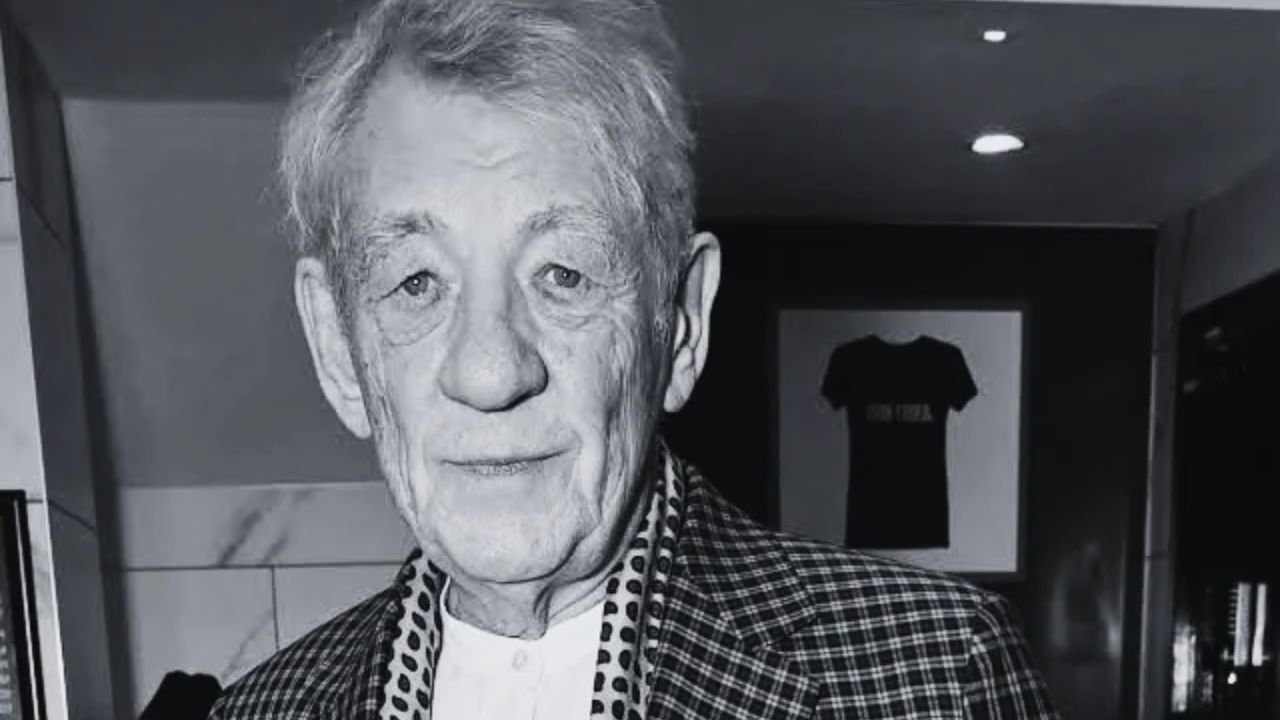

| Full name | Sir Ian Murray McKellen |
|---|---|
| Born | May 25, 1939, Burnley, Lancashire, England |
| Age | 85 |
| Nationality | British (English) |
| Profession | Actor |
| Known for | Gandalf in The Lord of the Rings; Magneto in X-Men; Shakespearean theatre |
| Parents | Denis Murray McKellen; Margery Lois Sutcliffe |
| Knighted | 1991, for services to the performing arts |
| Major awards | Tony Award (1981); six Laurence Olivier Awards; Golden Globe |
Sir Ian McKellen is one of the most recognisable actors working in the English-speaking world, and also one of the most frequently underestimated. To audiences who encountered him first as the wizard Gandalf or the brooding mutant Magneto, it can come as a surprise to learn that he had already spent four decades building one of the most distinguished stage careers in British theatre before either of those roles existed. His story is not simply about late-career global fame. It is about a life given entirely to performance, from a Lancashire childhood through Cambridge, decades of repertory and Shakespearean work, and eventually the kind of screen presence that stays with audiences for generations.
From Burnley to Bolton: Childhood and Early Influences
Ian Murray McKellen was born on May 25, 1939, in Burnley, Lancashire. His family later moved to Wigan and then to Bolton, and it was in that northern English environment that his early sense of language and storytelling was shaped. His father, Denis Murray McKellen, was a civil engineer and lay preacher — a combination that brought both practical discipline and a certain rhetorical seriousness into the household. His mother, Margery Lois Sutcliffe, encouraged a home atmosphere that was receptive to the arts.
Theatre entered his life early, and the family’s religious background gave him an instinctive feel for how words work on an audience. That foundation proved lasting. He lost his mother to breast cancer in 1951, when he was just twelve years old — a loss that came early and left a permanent mark. His father survived until 1963, dying in a car accident only two years after McKellen began his professional career.
McKellen’s Parents and Siblings
Denis Murray McKellen and Margery Lois Sutcliffe raised two children in the north of England. Ian’s older sister, Jean McKellen, later known as Jean Jones after her marriage, was born in 1934 and was five years his senior. The siblings were close, and Jean remained part of his life until her death in 2003. Beyond the immediate family, the household’s blend of civic duty, religious conviction and openness to culture provided the kind of upbringing that made a career in the arts feel not like an escape but like a natural extension of how he had been taught to engage with the world.
Cambridge, Repertory Theatre and a Career Without Drama School
McKellen did not take the route that many assume. He never attended drama school. Instead, he studied English at the University of Cambridge, graduating with a Bachelor of Arts in 1961. His practical theatrical training came through university drama societies, which at Cambridge in the late 1950s and early 1960s were serious and well-resourced environments for developing performance skills.
Immediately after graduating, he began his professional career at the Belgrade Theatre in Coventry, playing Roper in Robert Bolt’s A Man for All Seasons. From there he worked steadily through British repertory theatre across the 1960s, building a reputation through sustained live work rather than any single breakthrough moment. He made his West End debut by 1965. This path — Cambridge English, repertory graft, no conservatoire — is central to understanding how he developed his particular relationship with text and language on stage.
Shakespearean Stage Work and the 1981 Tony Award
Long before he became a household name in cinemas, McKellen had established himself as one of Britain’s foremost Shakespearean actors. His work associated with the Royal Shakespeare Company placed him at the centre of British classical theatre, and his reputation extended to Broadway. In 1981 he won the Tony Award for Best Actor in a Play for his portrayal of Antonio Salieri in Peter Shaffer’s Amadeus — a role that demanded both intellectual precision and emotional force, and which confirmed his standing as an international stage actor of the first rank.
Over the course of his career he accumulated six Laurence Olivier Awards, the most prestigious recognition available in British theatre. These were not honorary gestures but the result of repeated, sustained excellence across different productions and genres. His classical discipline — the ability to inhabit a character through language rather than relying on cinematic shorthand — directly informed the authority he later brought to screen roles.
That commitment to live theatre never faded. In June 2024, at the age of 85, McKellen was performing in Player Kings at a London venue when he fell from the stage. He suffered a fractured wrist and a chipped vertebra and was hospitalised. He withdrew from the production, but by subsequent accounts he had no intention of treating the accident as the end of his performing life.
Gandalf, Magneto and the Screen Career
McKellen’s transition to global film stardom came later than it does for most actors, and it came in spectacular fashion. In 2000 he began playing Erik Lehnsherr, better known as Magneto, in the X-Men film series. The role could have been merely decorative — a veteran actor lending credibility to a comic-book franchise — but McKellen brought genuine moral complexity to a character whose worldview, however destructive, had comprehensible roots in historical trauma. He appeared in multiple instalments of the series and remained one of its most compelling figures throughout.
In 2001 came the role that most of the world now associates with him most immediately: Gandalf the Grey in Peter Jackson’s The Lord of the Rings: The Fellowship of the Ring. McKellen’s performance — authoritative, warm, occasionally fierce, always anchored in something that felt genuinely ancient — became one of the most celebrated in the history of fantasy cinema. He reprised the role across the entire original trilogy, which concluded in 2003, and returned again for all three films in Jackson’s Hobbit trilogy between 2012 and 2014. The performance earned him an Academy Award nomination for Best Supporting Actor.
That was his second Oscar nomination. The first came in 1998 for his portrayal of director James Whale in Gods and Monsters, a quieter and more intimate film that demonstrated the range he brought to screen work. He did not win either award, but the nominations placed him among the most critically recognised actors of his generation.
Knighthood, Coming Out and Public Life
McKellen was knighted in 1991 for services to the performing arts — a recognition of a career that had already achieved extraordinary breadth across three decades. The honour formalised a standing that the theatre world had long acknowledged.
Three years before his knighthood, in 1988, he had made a decision that carried a different kind of significance. McKellen publicly came out as gay during a BBC radio discussion about proposed legislation that would have restricted the teaching of homosexuality in schools. The act was deliberately public and politically timed. He became one of the most prominent figures in British LGBTQ+ advocacy, and his visibility as an openly gay man in mainstream entertainment helped shift public conversation at a time when that was not a comfortable or commercially safe position to take. His activism has remained consistent over the decades, and he has spoken candidly about how the experience of coming out affected his understanding of his own work and life.
A Career Still in Motion
What is striking about McKellen’s career, viewed as a whole, is how little of it followed a conventional trajectory. He did not become famous young. He did not follow drama school with a quick West End run and then Hollywood. He built something slowly, from the inside out, through work that was often demanding and sometimes obscure, until the accumulated weight of it made him impossible to ignore. For readers interested in the full scope of his output — stage, screen and public life — resources like First Business Mag offer broader context on figures whose careers cut across multiple industries and eras.
After the 2024 accident during Player Kings, there was predictable speculation about whether he would step back from performing. The available evidence suggests he has not. Reports from 2025 indicate he missed a film festival appearance on medical advice, but also that he continued to work on new projects. At 85, after more than six decades of professional performance, Ian McKellen remains — by his own account and by the account of those who work with him — an actor, not a monument to one.
His career is a reminder that longevity in performance is not simply a matter of endurance. It requires continued willingness to take risks, whether that means falling from a stage in your mid-eighties or coming out publicly at the height of a career built in a less tolerant era. McKellen has done both, and the body of work he has produced across theatre and film stands as something genuinely rare in British cultural life.