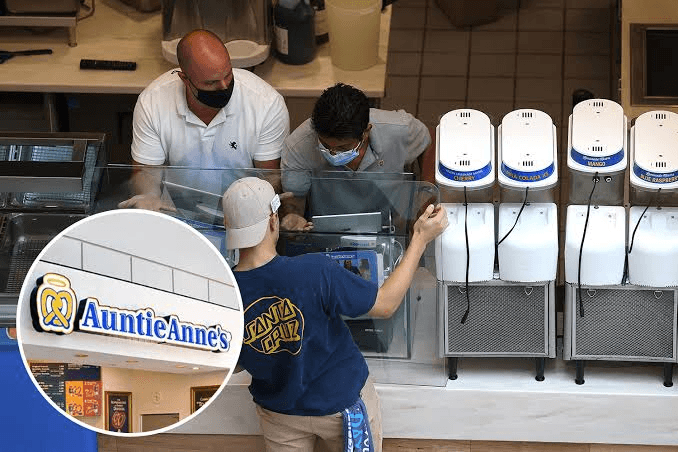

A sign appeared on the door of an Auntie Anne’s location at Lycoming Mall in Pennsylvania. It read: “We held on as long as we could.” The photo spread online fast, and a lot of people drew the same conclusion — the pretzel chain was done.
That conclusion was wrong. But it wasn’t an unreasonable thing to wonder.
If you’ve seen your local Auntie Anne’s close, or if you’ve read headlines about mall stores shutting down across the country, this article will give you a straight answer. We’ll cover whether the brand itself is collapsing, why specific locations have been closing, how the franchise model fits into all of this, and what the company is actually doing right now.
Auntie Anne’s Is Not Going Out of Business — But Some Locations Are Closing Permanently
Let’s answer the core question first: there is no credible evidence that Auntie Anne’s is shutting down as a brand. The company is still operating, still franchising, and still opening new locations in some markets.
What is true is that individual locations have closed — and some of those closures are permanent. The Lycoming Mall store closed for good. The Nittany Mall location in Pennsylvania closed after 24 years. A combined Auntie Anne’s and Carvel spot at the Shops at Ithaca Mall in New York shut down after more than a decade of operation.
These closures are real. But they don’t tell you what’s happening to the brand overall.
Think of it like movie theaters. When a local cinema shuts down, it doesn’t mean the studio that made the films is gone. The same logic applies here. A franchise location closing is a local business decision, not a company-wide collapse. Understanding that distinction is the key to reading this situation clearly.
The Franchise Model Explains Why Stores Close While the Brand Continues
Auntie Anne’s was founded in 1988 in Pennsylvania and grew almost entirely through franchising. Today, the brand is owned by Focus Brands, which also owns Cinnabon, Jamba, and Carvel. But the individual stores? Most of them are owned and operated by independent franchisees — not by corporate.
That matters a lot when you’re trying to understand closures.
Each franchisee runs their own business. They sign their own lease, hire their own staff, and manage their own costs. When traffic drops or rent gets too high, the franchisee makes a local call about whether to stay open. Corporate can’t simply keep a struggling store running if the franchisee decides it no longer makes financial sense.
When the Lycoming Mall location closed, a company spokesperson confirmed it was a permanent closure — but also made clear that the store was independently owned. That’s not a disclaimer. That’s the actual structure of how this business works.
Franchise units also get bought and sold. In 2022, a company called Fresh Dining Concepts acquired 73 Auntie Anne’s stores in a single deal, taking over from the second-largest franchisee in the system. That made Fresh Dining Concepts the largest Focus Brands franchisee in the snack category. Investors don’t buy 73 locations of a brand they think is about to collapse. That kind of acquisition signals confidence, not a sinking ship.
Why So Many Mall Locations Have Closed
Auntie Anne’s built its growth strategy around mall food courts. The logic was simple and it worked for a long time: high foot traffic, hungry shoppers, and the smell of fresh pretzels pulling people in as they walked past.
But that strategy has a vulnerability. It depends entirely on people being in the mall.
US mall traffic has been declining for years, driven by the growth of e-commerce. COVID-19 made things worse by accelerating habits — remote work, online shopping, fewer reasons to spend an afternoon at the mall. As anchor tenants left and foot traffic thinned out, food court vendors lost the customer volume they needed to cover rent and stay profitable.
The closures at Nittany Mall, Lycoming Mall, and the Ithaca Mall follow that pattern. The Ithaca location was particularly illustrative — when it closed, Subway had also left the same food court. These weren’t isolated failures. They were symptoms of a broader retail environment that has been hard on mall-dependent businesses across the board.
None of this means Auntie Anne’s made bad decisions. Mall food courts were genuinely strong locations for decades. The environment changed around them.
What Auntie Anne’s Is Doing Instead of Malls
Here’s where the story shifts from “closures” to “strategy.”
Auntie Anne’s isn’t just watching mall locations disappear and doing nothing. The brand has been actively moving into new formats and non-mall channels.
In 2021, Auntie Anne’s opened its first-ever drive-thru location in Texas, co-branded with Jamba. That’s a meaningful shift. A drive-thru doesn’t depend on mall traffic. It captures a different kind of customer — commuters, families running errands, people who wouldn’t set foot in a food court.
The chain has also added food trucks, which give franchisees flexibility to reach customers at events, high-traffic outdoor spots, and areas without traditional retail space. And airport locations — including one at Atlanta’s airport — show that the brand is placing itself in travel hubs where foot traffic is consistent and captive.
Focus Brands is also actively pursuing co-branded and multi-concept locations. Putting an Auntie Anne’s and a Jamba or Carvel in the same space lowers overhead, reduces build-out costs, and makes smaller or non-traditional locations financially viable. This approach opens up a much wider range of possible sites than a standalone mall kiosk ever could.
New locations have been reported in smaller markets as well. The brand is filling spaces in non-traditional spots rather than simply pulling back. The overall picture is a business adapting to a changed retail environment — not one preparing to shut down.
How to Check on Your Local Auntie Anne’s
If you’re wondering about a specific location, here’s a practical approach:
- Search the location on Google Maps or Yelp. Both will typically show whether a store is listed as “temporarily closed” or “permanently closed.”
- Use the official Auntie Anne’s store locator on their website to find currently operating locations near you.
- Check local news or the mall’s social media page. Closures like the Nittany Mall and Lycoming Mall were covered by local outlets before and after they happened.
A “permanently closed” tag doesn’t mean the brand is gone — it means that specific franchisee made a local decision to close that unit.
What to Watch Going Forward
The direction Auntie Anne’s is heading is fairly clear based on what’s already happening.
Expect more co-branded locations with other Focus Brands properties. The math on those works better than standalone units in declining mall environments, so the incentive to keep building them is strong.
Expect continued movement away from traditional mall food courts and toward airports, drive-thrus, street-level retail, and food trucks. The brand’s core product — warm, fresh pretzels — travels well across formats. It doesn’t need a food court to work.
Franchise consolidation is also likely to continue. When larger operators like Fresh Dining Concepts buy up dozens of units, it often leads to more professional management, better cost control, and more consistent operations. That kind of activity usually strengthens a franchise system, not weakens it.
For anyone tracking franchise trends or retail business news, resources like First Business Mag cover these kinds of strategic shifts across industries — worth keeping an eye on if you follow brands navigating major market changes.
The Bottom Line
Auntie Anne’s is not going out of business. The brand is owned by a large multi-concept company, continues to franchise actively, and recently attracted a major investor who bought 73 locations in one transaction.
What is happening is that the brand’s traditional home — the mall food court — is struggling. That’s putting pressure on individual franchisees in weaker mall environments, and some of them are closing. Those closures are real and, for the communities that lose them, genuinely disappointing.
But a franchise location closing is not the same as a company shutting down. The brand is still here, still operating, and actively building formats that don’t depend on mall foot traffic to survive.
If your local Auntie Anne’s is gone, that’s a local story. The brand itself is still very much open for business.
Also Read This: